Protected: 10 — Developing Quantum Digital Twins for the Industry (Part 2)
There is no excerpt because this is a protected post.
Protected: 10 — Developing Quantum Digital Twins for the Industry (Part 2) Read Post »
There is no excerpt because this is a protected post.
Protected: 10 — Developing Quantum Digital Twins for the Industry (Part 2) Read Post »

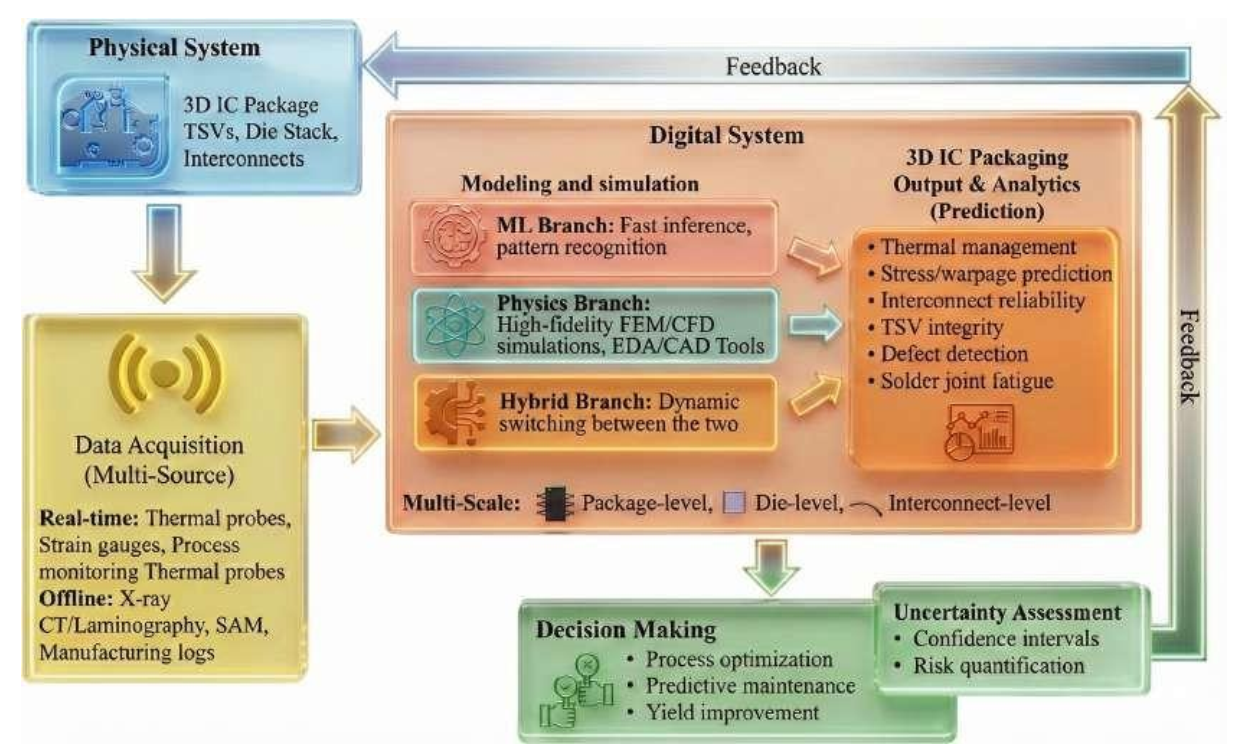
Industrial digital twins have matured from static models into live operational systems that can monitor status, detect anomalies, predict behavior, and prescribe future operations; in manufacturing, they are already used for machine health, scheduling, maintenance, and virtual commissioning. The next step is not to replace the digital twin. It is to add a quantum execution layer on top of it so that the twin can hand off the hardest subproblems—routing, scheduling, layout, BoM selection, and constrained optimization—to QAOA, VQE, or related hybrid methods.
9 — Developing Quantum Digital Twins for the Industry (Part 1) Read Post »
Hamiltonians, hybrid circuits, and deployment patterns Continuing the pipeline from Page 7, the essential move is to convert the sensor-informed
8 — Combining Quantum Sensing with Quantum Computing (Part 2) Read Post »

Quantum sensors already underpin atomic clocks, spin-based magnetometry, superconducting magnetometers, and MRI-like measurement modalities whereby quantum states are used to measure physical quantities with higher sensitivity or precision than classical counterparts. The new opportunity combines quantum sensing outputs with quantum computation so that downstream computation extracts the task-relevant information directly. This is the emerging quantum computational-sensing paradigm: rather than reconstructing every detail of the raw signal, the pipeline is designed to output only what the industrial task needs, with less sensing time and potentially better task accuracy.
7 — Combining Quantum Sensing with Quantum Computing (Part 1) Read Post »
Quantum 2.0 Beyond Computing While quantum computing attracts headlines, quantum sensing is already delivering near-term impact. Quantum sensors exploit: Applications
6 – Challenges in Quantum Sensing & Metrology: From Lab Precision to Field Deployment Read Post »
From Promise to Practicality In the previous pages, we explored: Now we confront a necessary reality: Quantum computing is advancing
5 – Challenges in Quantum Computing: Engineering the Climb from NISQ to Fault Tolerance Read Post »
From Algorithms to Circuits In Page 3, we explored what quantum algorithms do. Now we examine how they are implemented.
4 – Elements of Quantum Computing: Quantum Gates and Typical Quantum Pipelines Read Post »
From Quantum Physics to Business Advantage In the previous pages, we established the scientific foundation of quantum mechanics and traced
3 – Quantum Algorithms Explained for Business Leaders & Industry Practitioners Read Post »

Lorem Ipsum has been the industry’s standard dummy text ever since the 1500s when an unknown printer took a galley

Lorem Ipsum has been the industry’s standard dummy text ever since the 1500s when an unknown printer took a galley
Vulnerability Assessement Read Post »