Building a quantum application layer for industrial optimization
Industrial digital twins have matured from static models into live operational systems. NIST describes digital twins as systems that can monitor status, detect anomalies, predict behavior, and prescribe future operations; in manufacturing, they are already used for machine health, scheduling, maintenance, and virtual commissioning. NIST also notes that its 2024 advanced-manufacturing work is tied to standards, including ISO 23247.
The next step is not to replace the digital twin. It is to add a quantum execution layer on top of it so that the twin can hand off the hardest subproblems—routing, scheduling, layout, BoM selection, and constrained optimization—to QAOA, VQE, or related hybrid methods.
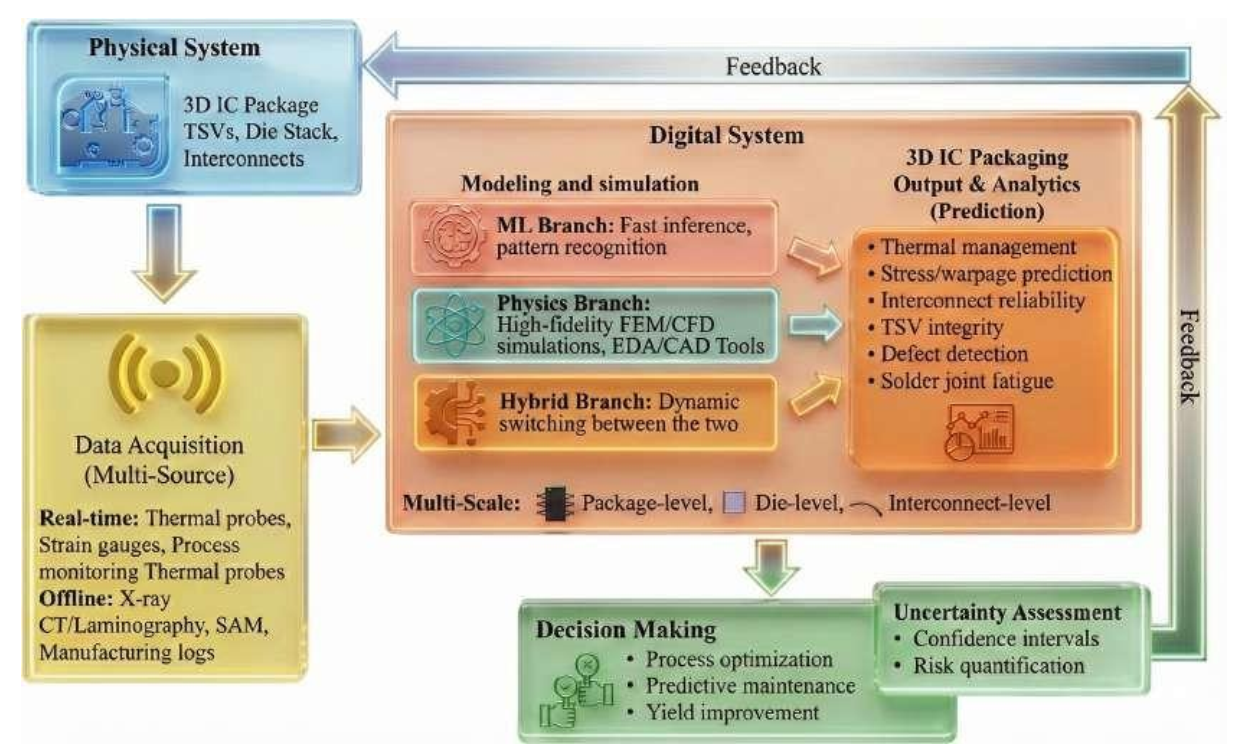
That is the core architecture: physical asset → IoT / sensors → classical digital twin → quantum-classical interface → quantum framework → QPU → operational system update.
Open-source frameworks are already available to support that pattern. Eclipse Ditto is an open-source digital-twin framework for connected devices, while Eclipse BaSyx is an Asset Administration shell-based twin stack with live data exchange over OPC UA and MQTT. PennyLane provides templates for embedding data and building variational circuits, and Qiskit Optimization provides automatic conversion from optimization problems to Ising Hamiltonians.
Table 1 — Quantum Digital Twin stack
| Layer | Role | Best-fit tools | Industrial value |
|---|---|---|---|
| Physical asset | Machine, grid, chiplet, warehouse, product | PLC, SCADA, MES, IoT sensors | Real-time operational truth |
| Classical digital twin | State, physics, ML, co-simulation | Eclipse Ditto, BaSyx, OpenTwins | Live asset model and synchronization |
| Quantum-classical interface | Problem extraction, encoding, penalties | QUBO, Ising, amplitude/angle embedding | Translates operations into quantum-native form |
| Quantum layer | Optimization, inference, variational search | Qiskit, PennyLane | Solves the hard combinatorial subproblem |
| QPU / cloud | Execution on hardware or simulator | IBM Quantum, Rigetti, IonQ | Iterative runtime with real execution |
| Operational systems | ERP, SCADA, MES, TMS | SAP, Oracle, plant systems | Decision deployment and closed-loop control |
1. Why a Quantum Digital Twin matters
The business case is straightforward: many twin-driven industrial tasks are not limited by sensing or simulation alone; they are limited by combinatorial explosion. The central move is to turn twin outputs into optimization variables, then solve them through QAOA, VQE, or Quantum-assisted Search. That is the right abstraction for energy scheduling, production sequencing, BoM selection, chiplet placement, and supply chain design.
The most practical first version is not a “fully quantum twin.” It is a classical twin plus a quantum solver service. That distinction matters. Qiskit Functions explicitly frame the software layer as a way to abstract away parts of the development workflow, which is exactly what an application layer should do for non-quantum specialists.
The more ambitious version is a twin orchestrator: the user defines industrial constraints in business language, the platform compiles them to a QUBO/Ising objective, runs the solver, and writes the result back to the twin state. In that model, the quantum layer is a backend service, not a research artifact. This is also consistent with Qiskit Runtime sessions, which are designed for iterative calls and prioritization during repeated optimization loops.
Table 2 — What changes with a Quantum Digital Twin
| Capability | Classical DT | Quantum DT layer |
|---|---|---|
| State update | Yes | Yes |
| Physics / simulation | Yes | Yes |
| Optimization under constraints | Classical heuristics / MILP | QAOA / VQE / quantum-assisted solvers |
| Inverse problem solving | Approximate | Hamiltonian-based formulation |
| Multi-objective tradeoffs | Mostly heuristic | Penalty Hamiltonians and variational objectives |
| User interface | Engineering-centric | SaaS-like problem builder + solver orchestration |
2. General onboarding architecture
We propose a clear onboarding architecture: physical asset, sensors, classical DT framework, quantum-classical interface, quantum framework, QPU, classical post-processing, and operational system update. Our proposed architecture is appropriate for industry because it preserves existing OT/IT investments while inserting quantum computation only where it adds leverage.
Step 1 — Capture the twin state
A twin should store not only current state, but also metadata: timestamps, operating mode, confidence, calibration state, and the source of each measurement. NIST’s digital-twins framing explicitly includes monitoring, anomaly detection, prediction, and prescription, which all depend on a well-structured state model.
Step 2 — Extract the optimization problem
The quantum layer should receive a compact mathematical problem, not raw telemetry. In practice that means:
- decision variables,
- constraints,
- objective function,
- penalty weights,
- and uncertainty tags.
Step 3 — Convert to QUBO or Hamiltonian form
Qiskit Optimization converts constrained optimization problems into QUBO and then to Ising operators. Its MinimumEigenOptimizer supports binary and integer variables by expanding integers into binary variables and adding weighted penalties.
Step 4 — Execute the quantum routine
Use QAOA for discrete scheduling and layout, VQE for energy-minimization-style models, and PennyLane for compact hybrid QML layers. PennyLane’s templates are built for embedding data and composing variational ansatzes, which makes them useful for an application-layer approach.
Step 5 — Write the result back to the twin
The resulting bitstring, distribution, or expectation value updates the twin and then propagates into ERP, MES, SCADA, or TMS. We emphasize this bidirectional closing of the loop.
[Image placeholder: General Quantum Digital Twin onboarding architecture showing Physical Asset → Sensors → Classical DT → Quantum Interface → Qiskit/PennyLane → QPU → Operational Systems. Fetch from https://eclipse.dev/ditto/intro-overview.html.]
3. Use case 1 — Smart grid and industrial energy optimization
The first application is in industrial energy scheduling: a manufacturing plant must schedule compressors, HVAC, furnaces, and motors to reduce energy cost while satisfying production demand. It proposes a QUBO with binary on/off variables and a demand penalty term, and it expects a 15–25% energy-cost reduction with real-time rescheduling in under one minute rather than hours.
This is a natural fit for a quantum digital twin because the twin already knows the live asset state, while the quantum layer handles the constrained allocation problem. In a modern plant, the digital twin can ingest SCADA or BMS data, then re-optimise scheduling as prices, loads, or production requirements change. NIST’s digital-twins framing for manufacturing explicitly includes schedule evaluation and maintenance planning, which matches this workload.
Quantum formulation
A simple binary formulation is:
where is the on/off decision, is price, is energy use, and captures demand constraints. We use the same structure and maps it to an Ising Hamiltonian for QAOA.
Qiskit implementation pattern
from qiskit_optimization import QuadraticProgram
from qiskit_optimization.converters import QuadraticProgramToQubo
from qiskit_algorithms import QAOA
from qiskit_algorithms.optimizers import COBYLA
from qiskit.primitives import StatevectorSampler
from qiskit_optimization.algorithms import MinimumEigenOptimizer

# Build a toy energy-scheduling problem
qp = QuadraticProgram()
qp.binary_var("asset_0_t0")
qp.binary_var("asset_1_t0")
qp.binary_var("asset_2_t0")

# Objective: minimize operating cost
qp.minimize(
    linear={"asset_0_t0": 3.0, "asset_1_t0": 2.0, "asset_2_t0": 4.0}
)

# Example demand constraint
qp.linear_constraint(
    linear={"asset_0_t0": 1, "asset_1_t0": 1, "asset_2_t0": 1},
    sense=">=",
    rhs=1,
    name="demand"
)

qubo = QuadraticProgramToQubo().convert(qp)

sampler = StatevectorSampler()
qaoa = QAOA(sampler=sampler, optimizer=COBYLA(maxiter=150), reps=2)
solver = MinimumEigenOptimizer(qaoa)
result = solver.solve(qubo)

print(result.x, result.fval)
Qiskit’s QUBO-to-Ising conversion and minimum-eigen workflows are designed for exactly this style of scheduling problem.
Table 3 — Energy twin summary
| Element | Detail |
|---|---|
| Digital twin | Live operational state of loads, tariffs, constraints |
| Decision variables | Binary on/off scheduling |
| Hamiltonian | QUBO / Ising with demand penalties |
| Quantum method | QAOA |
| Expected outcome | 15–25% lower energy cost; sub-hour rescheduling |
4. Use case 2 — Industrial manufacturing scheduling
The second application is job-shop scheduling, which is NP-hard and therefore a strong candidate for quantum optimization. We model machines, jobs, and resources as a scheduling twin and proposes QAOA with Grover-style constraint handling or QUBO conversion via Qiskit. It expects about 30–40% makespan reduction and on-the-fly recovery after machine failures.
This is where a digital twin becomes especially valuable: it contains the machine capacities, setup times, failures, and maintenance history, while the quantum layer searches the feasible schedule space. NIST’s advanced-manufacturing digital-twins work explicitly calls out requirements formulation, model validation, and actionable recommendations, all of which are essential for scheduling.
Why classical preprocessing still matters
Before invoking QAOA, the twin should simplify the scheduling graph:
- eliminate infeasible machine-job assignments,
- bucket jobs by compatibility,
- encode setup penalties,
- and insert failure probabilities.
That preprocessing is not a side note. It is the difference between a tractable QUBO and a noisy, over-parameterized one.
PennyLane-style circuit sketch
import pennylane as qml
import numpy as np

dev = qml.device("default.qubit", wires=4)

cost_h = qml.Hamiltonian(
    [1.0, 1.0, 1.5, 1.2],
    [qml.PauliZ(0), qml.PauliZ(1), qml.PauliZ(2), qml.PauliZ(3)]
)

mixer_h = qml.qaoa.mixers.x_mixer(wires=range(4))

@qml.qnode(dev)
def qaoa_circuit(gamma, beta):
    for w in range(4):
        qml.Hadamard(wires=w)
    qml.qaoa.cost_layer(gamma, cost_h)
    qml.qaoa.mixer_layer(beta, mixer_h)
    return qml.expval(cost_h)

print(qaoa_circuit(0.5, 0.2))
PennyLane’s QAOA modules are explicitly built to help construct mixer Hamiltonians and cost layers, which makes them useful for a twin-orchestrated optimization service.
Table 4 — Manufacturing scheduling summary
| Element | Detail |
|---|---|
| Digital twin | Machines, processing times, setup times, failure rates |
| Optimization target | Minimize makespan and disruption |
| Quantum method | QAOA |
| Classical support | Constraint pruning, failure estimation, job clustering |
| Expected outcome | 30–40% makespan reduction; dynamic re-optimisation |
5. Use case 3 — Product design and BoM optimization
The third application is Bill-of-Materials optimization. We frame the problem as selecting component variants under cost, weight, and performance constraints, with the twin implemented as an Asset Administration Shell system and the result exported back to ERP. It expects around 20–35% cost reduction versus classical greedy selection and better supplier diversity.
This is a particularly good fit for a quantum digital twin because product design already depends on structured component attributes. Eclipse BaSyx’s AAS submodels are well suited to representing those attributes, while the quantum solver handles the constrained combinatorial selection. BaSyx explicitly describes the AAS as one of the first implementations of digital twins and highlights live exchange via OPC UA and MQTT.
Hamiltonian pattern
A compact BoM objective is:
where the penalties enforce weight and performance constraints. That structure is exactly the kind of low-order polynomial that QUBO and Ising methods can absorb.
Qiskit example
from qiskit_optimization import QuadraticProgram
from qiskit_optimization.converters import QuadraticProgramToQubo
from qiskit_optimization.algorithms import MinimumEigenOptimizer
from qiskit_algorithms import QAOA
from qiskit_algorithms.optimizers import SPSA
from qiskit.primitives import StatevectorSampler

qp = QuadraticProgram()
for i in range(3):
    qp.binary_var(f"component_{i}")

qp.minimize(linear={
    "component_0": 5.0,
    "component_1": 3.0,
    "component_2": 4.0
})

qp.linear_constraint(
    linear={"component_0": 2, "component_1": 1, "component_2": 3},
    sense="<=",
    rhs=4,
    name="weight"
)

qubo = QuadraticProgramToQubo().convert(qp)
solver = MinimumEigenOptimizer(QAOA(StatevectorSampler(), SPSA(maxiter=100), reps=2))
result = solver.solve(qubo)
print(result.x)
Qiskit Optimization’s converters and minimum-eigen optimizers are built to carry problems from a high-level model to a QUBO/Ising target and then to a quantum-classical solver.
Table 5 — BoM optimization summary
| Element | Detail |
|---|---|
| Digital twin | Component submodels, supplier attributes, compliance data |
| Objective | Minimize cost while meeting weight/performance constraints |
| Quantum method | QAOA or VQE |
| Integration point | ERP export and design revision loop |
| Expected outcome | 20–35% cost reduction; better supplier resilience |
References
- NIST, Digital twins — monitoring, anomaly detection, prediction, and prescription framing.
- NIST, Digital Twins for Advanced Manufacturing — standards-oriented digital-twin workflow and use cases.
- NIST, Manufacturing Digital Twin Standards — ISO 23247 and standardization context.
- NIST, Economics of Digital Twins — cost-benefit and investment-analysis framing.
- Eclipse Ditto documentation — open-source digital-twin framework for connected devices.
- Eclipse BaSyx documentation — AAS-based digital twins and live data exchange.
- IBM Quantum / Qiskit docs — QAOA, VQE, QUBO-to-Ising mapping, Runtime sessions, and functions.
- Qiskit Optimization docs — converters and minimum-eigen workflows.
- PennyLane documentation — embeddings, templates, QAOA modules, and hybrid circuit building.
- arXiv review on supply-chain graph digital twins — supply-chain optimization framing.
- arXiv review on semiconductor 3D IC packaging digital twins — early-stage adoption context.